
Introduction
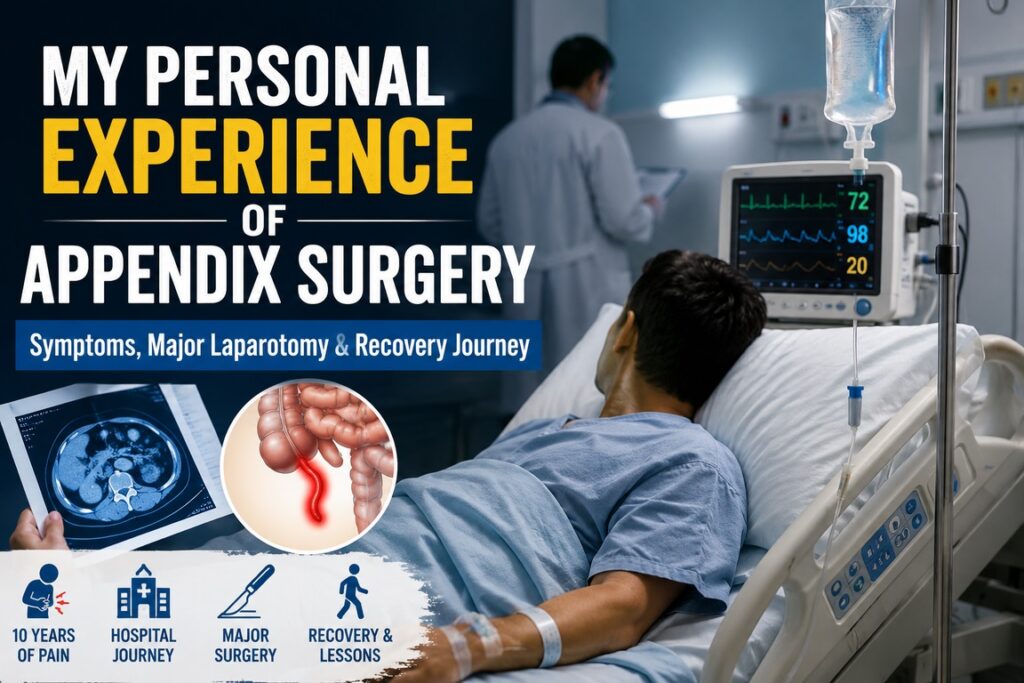
In this article, I am sharing my personal experience of appendix surgery. From the early symptoms to the surgery itself and the recovery process, everything mentioned here is based on what I personally went through. My purpose is to inform and help people who may face a similar situation in the future.
Symptoms and Health Issues

I had been suffering from this pain for about ten years. Whenever I visited a doctor, they told me it was just stomach pain. In the beginning, the pain would occur only once a year. Gradually, the attacks became more frequent. It increased from once a year to every few months, then every two to three months, and eventually it started occurring twice a month.I noticed that whenever I ate cauliflower, the pain would start. It also occurred whenever my stomach remained empty for a long time. For example, there were several occasions when I had breakfast in the morning but, because of office work, I could not eat lunch until 5:00 or 6:00 PM. Before I could even eat anything, the pain would begin. Even after eating, the pain did not improve.Each episode usually lasted for about a week. The pain would slowly decrease day by day until it disappeared.However, on 6 January 2025, the pain did not stop. It continued without any relief, so I went to a doctor. He gave me a No-Spa Forte injection, telling me that it was only normal stomach pain and that the injection would relieve it within ten minutes. He also prescribed some stomach pain syrups.
Unfortunately, neither the injection nor the medicines helped. The next day, I went for an ultrasound. That was when I found out that my appendix was inflamed. Hearing this completely shocked me because I had never undergone any surgery before, and I became extremely worried.
To confirm the diagnosis, I visited Burhani Hospital near Pakistan Chowk, Karachi. I showed my ultrasound report to the doctor. However, I later felt that my visit had not been helpful. He insisted that I needed an endoscopy and asked me to pay Rs. 30,000 for the procedure. He claimed that there were cuts in my intestine that needed to be examined and wanted to determine how deep they were.
He also prescribed medicines worth around Rs. 2,000, which I purchased, along with paying his consultation fee of approximately Rs. 2,000. Looking back, I realized that consulting that doctor did not help me understand or treat my actual problem rather then he was making his money from me.
Experience at Civil Hospital Karachi
I decided to get myself examined again at Civil Hospital Karachi. Going there was very difficult, and my overall experience was extremely unpleasant.
When I first visited the hospital, the doctors prescribed several blood tests. I completed all of them, but the entire process took almost a full day. I had arrived in the morning, and it was already afternoon by the time everything was finished.After receiving my blood test reports, I returned to the hospital for an ultrasound examination. I reached there at around 9:00 a.m. and waited until nearly 12:00 noon. When I finally met the doctor, she informed me that my urinary bladder was not full enough for the ultrasound and asked me to drink plenty of water before returning.I went outside, bought a bottle of water, and drank enough to fill my bladder. However, when I returned, I was told that the doctor had already left and that I would have to come back the following day.
I repeatedly requested them to perform the ultrasound because I had already spent several hours waiting, but they refused. As a result, nearly five hours of my time were wasted.I asked whether another doctor could perform the ultrasound, but they replied that only the same doctor who had instructed me to fill my bladder could conduct the examination.
The next day, I returned once again with a full bladder. Even then, I faced difficulties entering the department. After considerable effort, I was finally allowed inside. Ironically, the same doctor eventually performed my ultrasound.
I did not argue with her. She examined my appendix and concluded that appendicitis was the most likely cause of my problem.
Waiting for an ultrasound while trying to keep my urinary bladder full was one of the most uncomfortable parts of the entire process.
An Appendix Lump Developed

After several consultations, it became clear that I would most likely need appendix surgery. I visited the doctor again on 20 January 2025. This was the same doctor who had performed my ultrasound.
She informed me that I had developed an inflammatory lump around my appendix. She explained that the surrounding veins and tissues had naturally covered the appendix to help prevent it from bursting. According to her, this was the body’s own protective mechanism.
The doctor explained that if surgery was performed immediately, there was a risk of damaging the veins and tissues surrounding the appendix, which could lead to serious complications.
She told me that if I still wanted immediate surgery, I would have to provide written consent stating that the hospital would not be responsible if anything happened during the operation.
Hearing this frightened me, so I asked whether there was any alternative treatment.
Instead of operating immediately, the doctors admitted me to the hospital and kept me under observation. They explained that they would first try to reduce the lump with medicines.
This was the first time in my life that I had ever been admitted to a hospital. During my stay, I received injections and medicines. On 23 January 2025, after spending four days in the hospital, I was discharged.
Before leaving, I told the doctor that I would continue coming to the hospital to receive my injections and complete the prescribed treatment.
The doctor had completely restricted my normal diet. I was not allowed to eat roti and had to survive mainly on boiled rice and other light foods. Living without roti was extremely difficult for me, but I continued taking my medicines exactly as instructed.
Before I left, the doctor informed me that my surgery was planned for 1 March 2025, by which time she expected the appendix lump to have reduced enough for the operation to be performed safely.
Lost Consciousness and Was Admitted to the Hospital Again
On the morning of Friday, 21 February 2025, my condition suddenly became much worse.At approximately 8:30 a.m., I suddenly felt as if something had happened inside my body. I felt that my appendix might have burst. As soon as I stood up, my blood pressure dropped significantly, and I immediately lost consciousness.Fortunately, I regained consciousness within a few seconds.
After that, we called for a car and left for the hospital. During the journey, everything in front of my eyes gradually started turning dark. I kept trying my best to keep my eyes open, but despite my efforts, I could see nothing except darkness.When we arrived at the hospital, I was not in a condition to walk, so I was taken inside in a wheelchair.The doctor asked me to lie down on a bed and relax. He checked my blood pressure, examined my abdomen by pressing on it, and asked how I was feeling. After the examination, I was referred to the surgeon.
The surgeon advised me to undergo a CT scan. Since I had been instructed not to eat anything that morning, the scan was performed on an empty stomach.
The CT scan was scheduled for Saturday, 22 February 2025. Before I was taken for the scan, two cannulas were inserted into my hands.
My CT Scan Experience
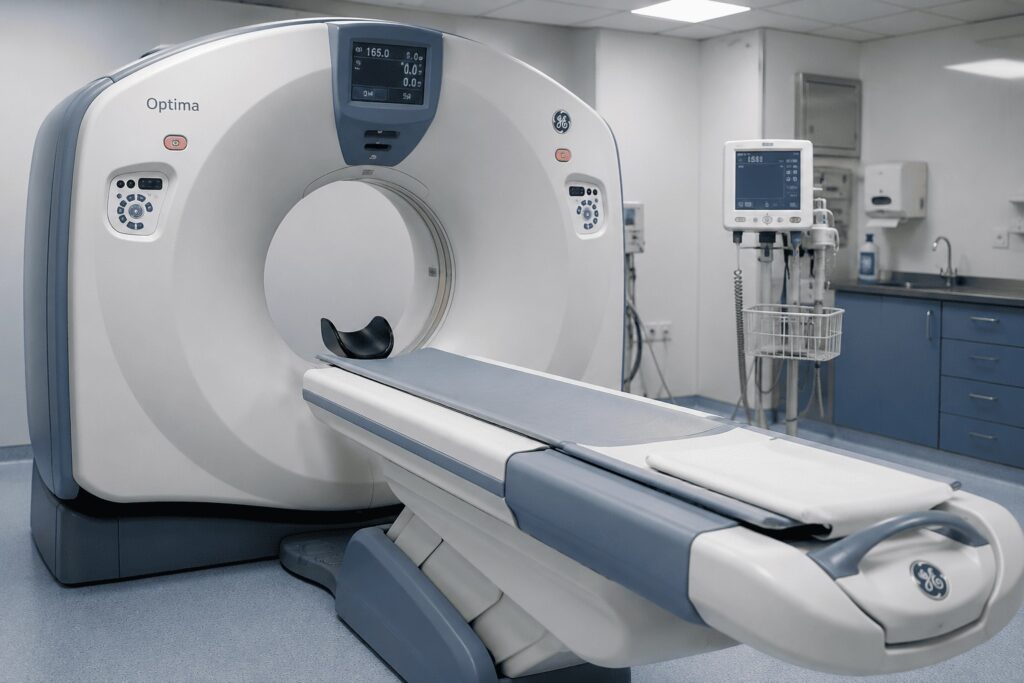
My CT scan was performed at another hospital located approximately 25 to 30 kilometers away. I was taken there by ambulance.
When I arrived, the two cannulas were still inserted in my hand.

The staff asked me to lie down on the CT scan machine. Before starting the scan, they explained that if I felt anything unusual or uncomfortable, I should immediately inform them so they could stop the procedure.
After positioning me on the machine, an injection was administered through the cannula in my left hand. The injection was controlled by the CT scan machine, and the operator activated it from outside the scanning room.
It is important to know that no one is allowed to remain inside the CT scan room except the patient being scanned. There are also no unnecessary metal objects inside the room because the equipment is highly sensitive.
As the machine began operating, it produced different computerized sounds. I was already physically weak because of my illness and emotionally exhausted due to everything I had been going through.When the operator activated the injection, I experienced a very unusual sensation. It felt as though something was rapidly traveling through my body from the cannula in my left hand, passing near my heart and spreading all the way to my eyes. Within seconds, the sensation spread throughout my entire body.I still find it difficult to describe exactly what it felt like. It seemed as if a thick liquid was moving rapidly through my body. It was one of the strangest sensations I have ever experienced.
During the scan, the staff instructed me to look upward, then to one side, and to hold my breath several times. I carefully followed all of their instructions.
The entire CT scan took approximately five to ten minutes, after which it was completed.
Waiting for the Surgery
Sunday was a holiday, so no further progress could be made because the doctor was not available. I was eager to have my surgery as soon as possible, but I had no choice except to wait.
Finally, on Monday, 24 February 2025, the next stage of my treatment began.
The doctor carefully reviewed my CT scan report and said that he could barely determine what was happening inside. He explained that the scan did not clearly show the actual cause of my pain. He also told me that he would only be able to see what was really happening once he opened my abdomen during the surgery.
After that, I underwent several tests to determine whether I was fit for anesthesia. These included an ECG and a chest X-ray.
The anesthesiologist asked me several questions about my medical history, including whether I had diabetes, high blood pressure, or any previous health problems.
I told him that I had none of these conditions and that I had been healthy apart from my appendix problem.
After reviewing all of my reports, the doctors informed me that I would need a laparotomy, which meant that my abdomen would have to be opened through a large surgical incision. The doctor carefully studied all of my reports before making this decision.
Choosing the Type of Anesthesia
Another major challenge for me was deciding between epidural anesthesia and general anesthesia.
An epidural is an injection given into the spine that numbs the lower half of the body, while general anesthesia makes the patient completely unconscious.
I had heard many frightening stories about epidurals. Some people said that if the injection was not given correctly, it could cause permanent back pain.
At the same time, I had also heard stories about general anesthesia, where people became unconscious and never woke up again.
Because of everything I had heard, making this decision was extremely difficult for me.
However, after reviewing my reports, the doctor explained that my condition had become serious and that I required a laparotomy, which is a major abdominal operation.
Since it was a major surgery, the doctor informed me that general anesthesia was the only suitable option.
The Night Before My Surgery
On Monday night, one day before the operation, the doctor told me:
“Whatever you want to eat, eat it now. After this, you must not eat or drink anything until your surgery and even after surgery.”
At around 10:00 or 11:00 p.m., I drank some apple juice and a little more liquid before beginning my fast.
By that time, I had almost completely lost my appetite. After spending so many weeks eating only light foods, I had become tired of the same restricted diet. The doctor had completely forbidden me from eating any solid food.
The Day of My Surgery
Finally, the day of my surgery arrived on Tuesday, 25 February 2025.
Since I had been fasting throughout the night, I hoped that my operation would be performed as early as possible. However, that did not happen. Another patient was scheduled before me at 9:00 a.m., and I was finally taken to the operation theatre at around 11:00 a.m.
I was extremely nervous.As I was being taken toward the operation theatre, I passed by one of its doors, which was open. I saw several doctors and medical staff working inside. The continuous beeping of the medical monitors made me even more anxious.
After that, I was taken into another room where an IV drip was connected to me. I suddenly started feeling very cold because both the air conditioner and the ceiling fan were running at the same time. I requested one of the staff members to switch off the air conditioner.
Those moments were very difficult for me. I was under a great deal of stress, but I kept trying to control my emotions because I was worried that if my blood pressure dropped, my surgery might be delayed. I kept telling myself to stay calm.
At around 12:00 p.m., I was finally taken into the operation theatre. I lay down on the operating table and continued trying to relax. By then, I had managed to control myself to a great extent.The cannulas were already inserted into both of my hands.
Receiving General Anesthesia
An anesthetist came and sat beside my head. She softly recited “Bismillah” before administering the anesthesia through the cannula.
Within a few moments, everything suddenly went dark before my eyes, and I lost consciousness.One thing I noticed was that while I was unconscious under anesthesia, I did not experience any dreams. It was as if everything became completely blank, and then, suddenly, I woke up in the ward.
Normally, we experience dreams because parts of the brain remain active during natural sleep. However, anesthesia seemed to put almost my entire brain into a deeply suppressed state. From my personal experience, it felt much deeper than ordinary sleep.
This was simply my personal experience. Other people may have different experiences under general anesthesia.
Waking Up After Surgery
When I regained consciousness, I was in severe pain.
My surgery had started at around 12:00 p.m., and I was shifted back to the ward at approximately 4:00 p.m.
As soon as I became conscious, the doctor asked me how I was feeling. I told him that I was in severe pain.
He immediately gave me another injection to help me sleep, along with a strong painkiller.
As I gradually became more aware of my surroundings, I was shocked to discover that a tube had been attached to my body. At that moment, I had no idea what it was for.One by one, my relatives came to see me and spoke to me, but I could barely respond because I had absolutely no energy. I was still very drowsy from the anesthesia and in a great deal of pain.Later that night, at around 10:00 p.m., I became fully conscious.
My First Walk After Surgery
The doctor came to examine me and told me that I needed to get up and walk.This was an extremely difficult task because only about six hours had passed since my surgery.At that time, I did not know that my wound had been closed with 19 steel staples.Two people supported me by holding me from both sides. With their help, I slowly managed to walk a short distance before returning to my bed.Even that small walk felt like a huge challenge because I was still in intense pain.
Forty-Eight Hours Without Food
The doctor allowed me to drink only one spoonful of water and strictly instructed me not to eat anything.
During the next 48 hours, I drank only four spoonfuls of water in total.Every eight hours, I was given glucose through an IV drip. It provided me with some energy, but it was nowhere near enough. I was desperately craving something to eat.Due to this diet schedule, I lost approximately 10 kg of weight my was 73kg then it decreased to 63kg.
The Drainage Tube
The doctor asked whether I wanted a urinary catheter to be inserted, but I refused.
I told him,
“No, I will somehow manage. Please don’t insert a urinary bag.”
I knew that inserting a urinary catheter is also an uncomfortable procedure, so I wanted to avoid it if possible.
Later that night, I looked more carefully and realized that the tube attached to me was not a urinary bag at all.It was actually coming directly out of my abdomen.
The tube had been placed to drain any blood, fluid, or other discharge from the surgical area into a collection bag outside my body.
At first, however, I had mistakenly assumed that it was a urinary bag.
A Very Painful Night After Surgery
To help control the pain, the doctors gave me an injection of Toradol, which is a very strong painkiller.
Even after receiving it, I spent the entire night in pain.My back hurt so badly that I could hardly sleep.I remained lying in the same position.
Surprisingly, the pain in my back was even worse than the pain from my surgical wound.Remaining in one position for the entire night after such a major operation was one of the hardest experiences I had ever gone through.Finally, morning arrived.
Seeing My Surgical Wound
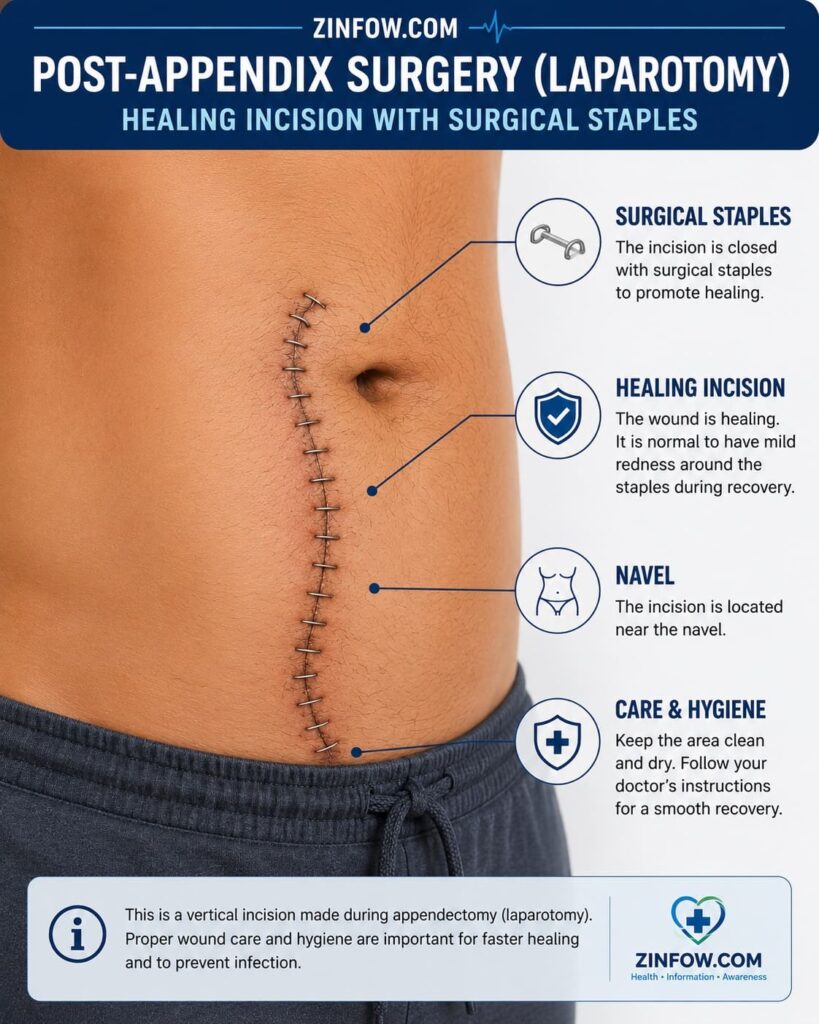
The next morning, the doctors came to examine me.
They removed the bandage covering my wound, and that was when I discovered that my incision had been closed with steel staples.
I also realized that my surgery had not been performed through the small incision normally used for an appendectomy.
Instead, my laparotomy incision extended from my belly button downward because my condition had become much more serious.
I also saw the drainage tube coming out of my abdomen and finally understood where it had been attached.
Even the slightest movement of that tube caused unbearable pain.During the examination, the doctor gently pressed on my abdomen, which was also very painful.
He explained that they needed to examine the area carefully to make sure everything inside was normal and that there were no signs of complications.
Why My Surgery Changed from an Appendectomy to a Laparotomy
The doctor then explained what had actually happened during my surgery.
He told me that my appendix had become stuck to my intestine. According to the doctor, the intestine has three layers, and the inflamed appendix had already damaged one of those layers. In other words, the appendix was not only becoming more damaged itself but was also damaging my intestine.
He explained that if the operation had been delayed any longer, the appendix could have completely perforated the intestinal wall. If that had happened, the contents of my intestine could have leaked into my abdominal cavity, making the situation life-threatening.
That was the reason the doctors had to perform a major laparotomy instead of a normal appendectomy.
In most appendix cases, the surgery is performed through a very small incision using minimally invasive techniques. In my case, however, the condition had become so serious that a major operation was the only option.
Honestly, I felt as if I had come back after touching death.
The doctor told me,
“You have been living with this appendix problem for nearly ten years. I still can’t believe how you remained alive for so long.”
He also said that although he had many years of surgical experience, he had never come across a case quite like mine.
Recovery in the Hospital
After the surgery, the doctor advised me to keep walking as much as possible.
However, I was still not allowed to eat solid food. Gradually, I was permitted to drink small amounts of liquids, including fresh fruit juices.
The doctor repeatedly emphasized the importance of walking. He explained that if I did not walk, my recovery could be be delayed and it could also affect my stitches and the healing of my surgical wound.
Despite the pain, I tried my best.
I slowly walked while holding onto the walls for support.
Throughout my stay in the hospital, I remained on intravenous drips. Sometimes they contained glucose, while at other times they contained saline and other fluids.
Those drips became my only source of strength because I was still unable to eat normally.
The doctor also explained that I could not be discharged until my bowel movements returned to normal.
My surgery had been performed on Tuesday, and for several days afterward I survived mainly on liquids.
Eventually, I was allowed to eat very soft foods, such as porridge, but everything had to be completely mashed.
Even then, I was still strictly forbidden from eating roti or any other solid food.
Finally, on Sunday, 2 March 2025, I was discharged from the hospital.
Before leaving, the doctor prescribed antibiotics and several other medicines to help me recover as quickly as possible.
My Stay in the Surgical Ward
During my stay in the surgical ward, I saw around 10 to 15 patients undergo surgery.
Almost all of them returned from the operation theatre fully awake because they had received epidural anesthesia.
I was the only patient who had undergone surgery under general anesthesia.
I also stayed in the ward longer than anyone else.
While most patients were discharged within one or two days after surgery, I remained admitted for approximately ten days.
Follow-Up Visits
About two weeks later, I returned to the hospital for a follow-up visit.
The doctor told me that I could gradually start eating semi-solid food.
Around fourteen days after my operation, my steel staples were removed.
That procedure was also quite painful.
My next follow-up visit took place about five weeks after the surgery.
During that visit, the doctor finally allowed me to eat thin roti.
That day, I felt so happy and realized the true importance of a simple roti.
I had not eaten roti for about two and a half months, and it had been one of the most difficult parts of my recovery.
My Recovery at Home
During my recovery, I mainly ate foods that were rich in fiber.I also ate steamed fish and continued walking regularly.
The doctor strictly instructed me not to lift heavy weights.As I write this article today, it is July 2026.
Even now, whenever I lift anything heavy, I still feel pain on the right side of my abdomen where the surgery was performed.
Final Thoughts
Everything that happened was truly a terrifying experience.
Only I know how much pain and suffering I went through.
The purpose of writing this article is to help people understand that no illness especially appendicitis should ever be taken lightly.
Ignoring symptoms or delaying treatment can lead to serious complications.
If I had undergone appendix surgery when my symptoms first began, it would most likely have been a simple operation with a small incision.
Unfortunately, the correct diagnosis was not made in the beginning. As I mentioned earlier, the doctors initially believed that I had a different problem.
By the time the correct diagnosis was finally made, my condition had already become much more serious.
Today, I am living a normal life.
However, I still avoid lifting heavy weights because I continue to feel discomfort near the area where the surgery was performed.
If sharing my experience helps even one person recognize the symptoms early and seek treatment without delay, then writing this article will have been worthwhile.